







NIMN Challenges Marketers to Rethink Growth Strategy as AI, Data Reshape Industry
The Lagos Chapter of the National Institute of Marketing of Nigeria (NIMN) has challenged marketing professionals to move beyond traditional advertising and embrace a new growth model driven by artificial intelligence (AI), customer experience, data ecosystems and purpose-led brands.
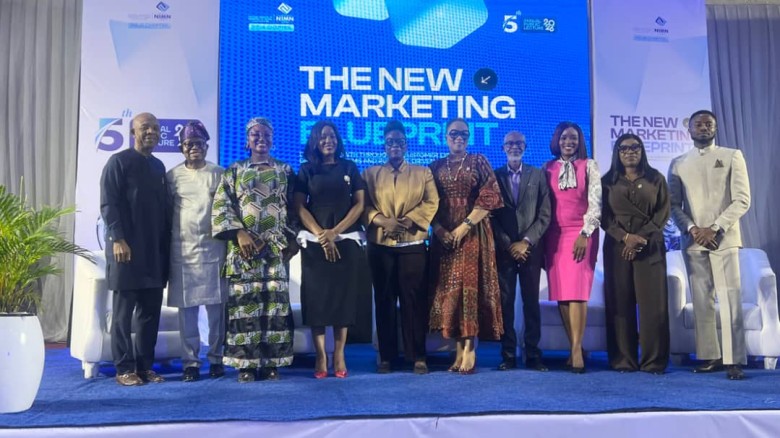
The call was made at the chapter’s 5th Public Annual Lecture, held on Wednesday, October 14, 2026, with the theme, “The New Marketing Blueprint: Driving Growth Through AI, Customer Experience, Data Ecosystems and Purpose-Driven Brands.”
The lecture brought together marketing professionals, academics and industry stakeholders to examine how rapidly changing consumer behaviour and technology are redefining the marketing profession.
Speaking at the event, Dr Bolajoko Bayo-Ajayi, FNIMN, FNIPR, CPC, President and Chairman of Council, NIMN, said marketing could no longer be defined solely by advertising and communications.
According to her, the discipline has evolved significantly, increasingly shaped by consumer insights and the changing expectations of consumers.
She noted that consumers are demanding more from brands, making relevance and trust critical to creating meaningful value.
“Consumers are not looking for the brands that have the most data. They are looking for the brands they can trust with the data they have,” she said.
Bayo-Ajayi added that NIMN was committed to equipping marketing professionals with the skills required to navigate the rapidly evolving marketing landscape.
Also speaking, Mrs Onome Odili, FNIMN, RPA, M.CIoD, FMD, Chairman, NIMN Ikeja Chapter, said the conversation around the future of marketing could not have come at a more critical time.
Odili, who is also Managing Director of FoodPluses, said the consumer, technology, data and competitive landscape had changed dramatically, while the speed of change had become even more significant.
She challenged marketers to look beyond simply adopting AI and ask whether the technology was actually making them better marketers.
“Data without insight is just information. AI without human intelligence can create efficiencies without necessarily creating value,” she said.
The keynote speaker, Lampe Omoyele, Managing Director/CEO, Nitro 121, said the traditional marketing playbook must be updated because the Nigerian consumer had fundamentally changed.
According to Omoyele, AI has empowered consumers to compare prices, interrogate brand claims and make more informed purchasing decisions, while rising expectations around customer experience have made consumers less tolerant of friction.
“The consumer is also very consumer-experience aware. They are not as patient as before. Speed and ease are important for the consumer today,” he said.
He noted that consumers were increasingly experiencing information fatigue, making it necessary for marketers to develop an interconnected model for sustainable growth built around strategy, data and purpose.
He identified four key principles: AI enables efficiency; customer experience drives retention; data ecosystems ensure precision; and purpose-driven brands build loyalty.
In his presentation, Professor Lere Baale, Pharmacist, Business Executive and Director, Business School Netherlands, stressed that marketing must remain firmly rooted in the consumer.
“Marketing begins with the consumer and it ends with the consumer,” he said, arguing that brands must move beyond customer service to create meaningful customer experiences.
Baale noted that while organisations were increasingly using technology to gather data, many still lacked the expertise required to properly mine and interpret that data.
He warned that technology could end up accelerating old marketing mistakes if organisations failed to combine technological capability with human intelligence and strategic thinking.
According to him, marketers should use AI to anticipate consumer needs, support decision-making and create value, while customer experience should be deployed to remove friction, deliver brand promises and earn loyalty.
He also emphasised that marketing was no longer the exclusive responsibility of the marketing department.
“Everybody in an organisation is a marketer,” he said, stressing that every customer touchpoint provides an opportunity to remove friction, deliver on promises and build loyalty.
Baale further called for stronger data ecosystems capable of connecting information responsibly to generate understanding and actionable insights, while urging brands to demonstrate their purpose through consistent value creation.
He said the future of marketing was not fundamentally about machines, algorithms, advertising platforms or digital channels, but about people with needs, choices and expectations.
According to him, technology has given consumers the power to compare, question, recommend or abandon brands within seconds, making loyalty something brands can no longer take for granted.
He therefore challenged marketers to move beyond asking how to reach more customers and instead focus on how to understand customers better, serve them more intelligently, earn their trust consistently and convert data and purpose into sustainable business growth.
The conversation continued during a panel session moderated by Aizehi Itua, Founder and CEO, Aim One Company, with industry experts reinforcing the need for marketers to rethink their relationship with data, technology and continuous learning.
Bodam Taiwo, Marketing Director, Africa Partner Markets at Diageo, stressed the importance of extracting meaningful insights from existing data rather than simply accumulating more information. Taiwo, who previously served as Customer Marketing Director for West and Central Africa at Diageo, said marketers needed to learn how to turn data into relevant insights that could improve organisational decision-making.
Kehinde Ruth Onasoga, MCIM, ARPA, MNIMN, Marketing Strategist and Founder of Pandora Global Agency, urged marketers to remain open to learning and unlearning as the profession continues to evolve.
Prof. Bolajoko Nkemdinim Dixon-Ogbechi, Professor of Marketing at the University of Lagos, highlighted the importance of applying a scientific approach to marketing while leveraging AI to understand patterns and parameters. She stressed the need to combine technology and analytical thinking with local cultural nuances to ensure that marketing remains relevant and relatable to consumers.
The overarching message from the lecture was clear: the next era of marketing will not be won simply by the brands with the most technology or the largest datasets, but by organisations capable of combining technology, insight, experience and purpose to create value that consumers can trust.
Leave A Comment