







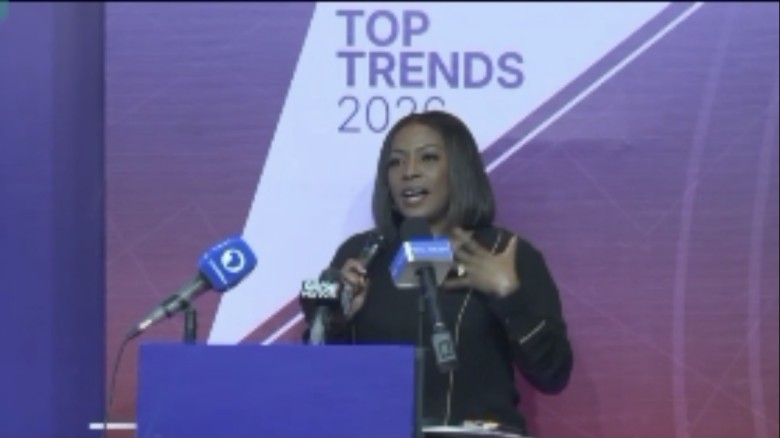
Dr Juliet Ehimuan: Why Sharper Insights—not More Data Will Disrupt Marketing in 2026
Dr Juliet Ehimuan, Founder of Beyond Limits Global and former Director of Google West Africa, has challenged marketers to rethink how disruption will occur in 2026, asserting that competitive advantage will no longer come from the volume of data available, but from the quality of insights derived from it.
She made this assertion while delivering a keynote presentation titled “Insight-Driven Decisions to Disrupt the Marketing Industry in 2026” at the Top Trends 2026 event organised by MediaReach OMD in collaboration with Lagos Business School (LBS), GeoPoll and the National Institute of Marketing of Nigeria (NIMN).
According to Ehimuan, insight-driven decision-making begins with asking the right questions. “Who exactly is our target customer? Who are our true competitors? And which channels truly deliver value?” she noted, stressing that clarity at this stage determines the effectiveness of all subsequent marketing decisions.
A major driver of this new era, she explained, is AI-powered hyper-localisation at scale. Artificial intelligence now enables brands to tailor messaging to diverse audiences without creating hundreds of campaign versions. Through AI, brands can adapt language, offers and content based on local behaviours and preferences, allowing a single strategy to power multiple localised campaigns. Real-time personalisation, she added, ensures brands remain culturally relevant and avoid tone-deaf messaging amid fast-moving cultural shifts.
Dr Ehimuan also highlighted how ongoing economic volatility is rendering traditional long-term planning cycles increasingly unreliable. In this environment, predictive insights are becoming critical. These insights help brands anticipate shifts in consumer behaviour, understand price sensitivity, and test responses to different offers and promotions under economic pressure.
Drawing attention to Nigeria’s unique retail landscape, she noted that over half of consumer spending occurs through informal channels such as kiosks, open markets and street trade, transactions that have historically been invisible to brands. However, retail technology and trade digitisation are changing this reality. Through agent networks, mobile data collection, micro-surveys, inventory scanning and SKU-level tracking, informal consumer behaviour is becoming measurable, enabling smarter, real-time decisions around distribution, pricing and promotions.
Beyond technology, Ehimuan emphasised a strong leadership imperative. Insight-driven disruption, she said, requires leaders who are willing to challenge norms, make bold decisions and move beyond isolated campaigns to orchestrating connected marketing ecosystems. Insight, she stressed, must sit at the heart of strategy and serve as the engine of innovation.
She concluded by noting that as tools and platforms become increasingly accessible to all players, the market will reward depth of understanding over sheer activity, strategy over random experimentation, and speed over legacy advantage. “In a level playing field, advantage will belong to brands that can interpret signals better, update assumptions faster, and translate insight into decisive action,” she said.
Leave A Comment