







Peer Influence Now Outweighs Advertising in Consumer Decisions, NIMN-LBS Study Reveals
A groundbreaking consumer insights report jointly developed by the Nigerian Institute of Marketing of Nigeria (NIMN) and Lagos Business School (LBS) has revealed a dramatic shift in how Nigerian consumers make purchasing decisions, with peer influence now exerting greater impact than traditional advertising.
The report, presented at the Annual Marketing Conference (AMC) and Annual General Meeting (AGM) of NIMN, offered fresh perspectives on the evolving dynamics of the modern marketplace and challenged marketers to rethink conventional engagement strategies.
Presenting the findings, Professor Uchenna Uzo, Deputy Vice-Chancellor of Pan-Atlantic University, described the current marketplace as a “battle for relevance,” where brands must compete not only for attention but also for trust, authenticity and meaningful consumer relationships.
According to the report, Nigerian consumers are becoming increasingly aspirational, driven largely by a culture of hope and resilience. Despite prevailing economic challenges, consumers continue to believe in the possibility of a better future, with influential figures such as church leaders, peer influencers and community leaders playing significant roles in shaping those aspirations.
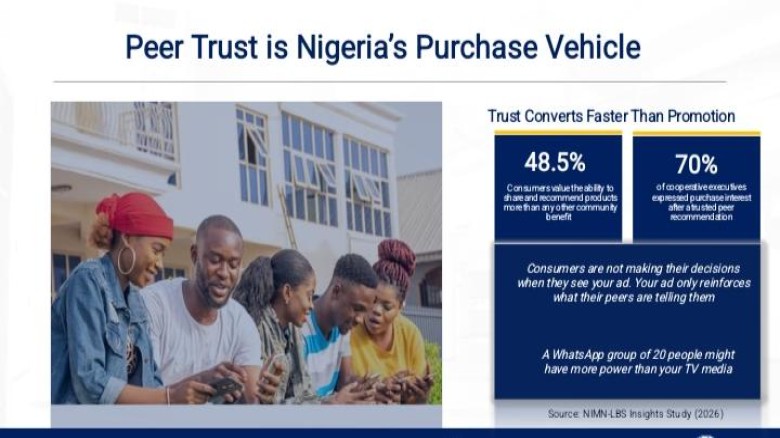
The study identified peer influencers as one of the most powerful forces in consumer decision-making, surpassing the influence of traditional advertising channels.
“Peer influence converts faster than promotion,” Professor Uzo noted, explaining that consumers increasingly rely on recommendations from trusted individuals within their social circles when making purchase decisions.
The report revealed that 48 per cent of consumers place greater value on their ability to share and recommend products than on any other benefit derived from being part of a community. In addition, 70 per cent of cooperative executives surveyed expressed purchase interest after receiving recommendations from trusted peers.
The findings suggest that advertising alone is no longer sufficient to drive consumer action.
“Consumers are not making their decisions when they see your advertisement. Advertising often serves to reinforce what their peers are already telling them,” Uzo explained.
Highlighting the growing influence of digital communities, he noted that a WhatsApp group of just 20 trusted individuals could potentially exert more influence on purchasing behaviour than a major television advertising campaign.
The report also underscored consumers’ growing desire for deeper engagement with brands. Rather than being passive recipients of marketing messages, consumers increasingly want to participate in shaping the products, services and experiences they consume.
According to the study, many consumers feel excluded from brand decision-making processes. While brands often claim to listen to customers, relatively few actively involve them in product development and innovation.
“Consumers do not just want a voice; they want ownership. They want to co-create,” Uzo said, urging organisations to move beyond feedback mechanisms and embrace collaborative engagement models.
The report further advised brands to invest more deliberately in community-building initiatives, arguing that strong communities can become powerful advocates and protectors of brands during challenging periods.
Another major finding of the study focused on the changing role of influencers in marketing communications. While influencers remain important for generating visibility, excessive reliance on influencer marketing is increasingly being viewed as a credibility risk.
“There was a time when celebrity endorsements automatically inspired trust. Today, consumers still pay attention to big names, but they do not necessarily believe them,” Uzo observed.
The report found that consumers increasingly perceive celebrity influencers as distant and disconnected from their realities, making authentic peer recommendations more persuasive and effective.
According to the study, influencer marketing can boost brand awareness, but overuse may weaken consumer trust and ultimately erode long-term brand loyalty.
The report also highlighted growing concerns around technology and consumer trust. While digital platforms have expanded brand visibility and engagement opportunities, they have simultaneously created new trust challenges.
Consumers expressed concerns about the technologies brands use to engage with them, suggesting that increased digital interaction has not necessarily translated into stronger human connections.
“We have moved from physical proximity to digital engagement, and in doing so, we have created a gap. While visibility has increased, trust has declined,” Uzo stated.
He warned that brands risk creating more noise than meaningful relationships if technology is deployed without a human-centred approach.
“If consumers do not trust the technology, they do not trust the brand,” he added.
Perhaps the most significant finding of the report was the growing importance of social responsibility as a driver of customer loyalty. According to the study, 95 per cent of consumers consider ethical conduct and sustainable business practices when making purchasing decisions.
The report concluded that while culture and connection help build communities, it is ethical behaviour and responsible corporate conduct that sustain them over time.
“Ethics builds culture and community. Culture and connection create communities, but ethics is what sustains them,” Uzo said.
The findings reinforce the central theme of the conference, “Community, Culture and Connection: Re-imagining the New Market,” and highlight the urgent need for brands to move beyond transactional marketing towards trust-based relationships rooted in authenticity, collaboration and shared value.
For marketers seeking relevance in an increasingly complex and digitally connected marketplace, the report offers a clear message: communities matter more than campaigns, trust matters more than technology, and people matter more than products.
Leave A Comment