







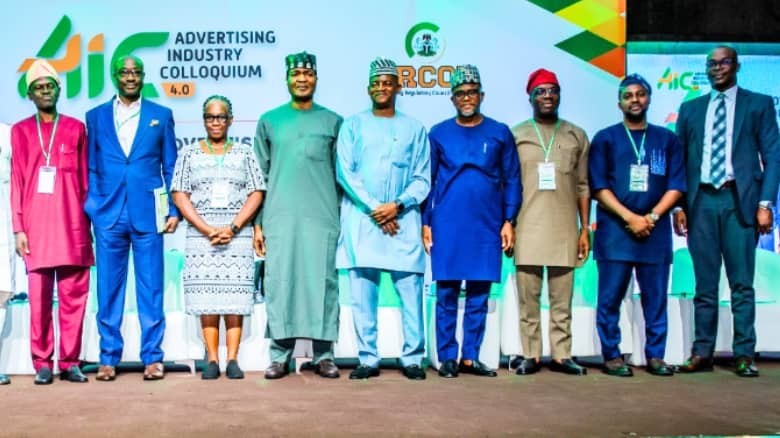
AIC 4.0 Charts Future of Advertising
Industry leaders, policymakers, regulators, academics and marketing communications professionals have called for stronger collaboration, agile regulation and responsible innovation to position Nigeria's advertising industry for the future.
The call was made at the fourth edition of the Advertising Industry Colloquium (AIC 4.0), organised by the Advertising Regulatory Council of Nigeria (ARCON), where stakeholders examined the evolving advertising landscape under the theme, "The Future of Advertising: The Role of Platforms, People and Regulation."
Honourable Minister of Information and National Orientation, Alhaji Mohammed Idris Malagi, represented by the Director-General of the Voice of Nigeria (VON), Mallam Jibrin Baba, said rapid advances in Artificial Intelligence (AI), digital platforms, big data and immersive technologies are fundamentally transforming how brands communicate, consumers engage with content and societies access information.
He noted that while these developments present enormous opportunities for Nigeria, they also demand a regulatory framework capable of keeping pace with innovation without suppressing creativity.
"Advertising has evolved far beyond selling products. It now shapes culture, influences public perception, drives economic activity, promotes national identity and supports democratic participation," he said.
The Minister stated that the Federal Government, under the leadership of President Bola Ahmed Tinubu, recognises the strategic importance of Nigeria's creative and advertising ecosystem in driving economic growth and digital transformation.
According to him, ongoing investments in national digital infrastructure, particularly the fibre-optic expansion programme, will significantly improve broadband penetration, reduce connectivity costs and expand access to high-speed internet across underserved communities, creating new opportunities for digital advertising, e-commerce and innovation-led businesses.
He identified Platforms, People and Regulation as the three critical pillars that will define the industry's future.
On digital platforms, Alhaji Mohammed Idris stressed the need for responsible governance to address concerns around misinformation, harmful content, privacy, data protection and market fairness while encouraging enterprise and innovation.
Speaking on people, he maintained that technology cannot replace human creativity, ethical judgment and strategic thinking.
"Artificial Intelligence may generate content, but authentic storytelling, cultural understanding, emotional intelligence and professional judgment remain uniquely human," he said.
He added that effective regulation should be viewed as an enabler of sustainable industry growth rather than an obstacle, noting that transparent and forward-looking policies are essential for protecting consumers, promoting fair competition and boosting investor confidence.
"I therefore commend ARCON for its ongoing efforts to modernise advertising regulation while engaging stakeholders across the industry. Regulation works best when it is consultative, adaptive and responsive to emerging realities".
He also urged stakeholders to work together in developing ethical frameworks around AI, content creation and intellectual property to ensure originality is protected while innovation continues to thrive.
"The future of advertising will not be determined by technology alone. It will be shaped by the quality of our ideas, the integrity of our institutions and the courage of our leadership. Let us therefore embrace innovation without abandoning ethics; pursue growth without compromising public trust; and build an advertising industry that reflects the creativity, resilience and aspirations of the Nigerian people".
Earlier, the Director-General of ARCON, Dr. Olalekan Fadolapo, described the Advertising Industry Colloquium as an important platform for fostering dialogue among regulators, practitioners, academia, students and emerging professionals on the future of advertising and marketing communications in Nigeria.
"The future of advertising cannot be shaped by one stakeholder alone," Fadolapo said. "It requires collaboration that inspires innovation, stakeholders who uphold creativity and ethical practice, and a regulatory framework that promotes trust, protects consumers and supports sustainable industry growth."
He expressed confidence that continued collaboration would help build a resilient, globally competitive advertising ecosystem capable of responding to the changing needs of society.
Chairman of the Advertising Industry Colloquium and Journal Committee, Professor Rotimi Olatunji, said the annual gathering has become a unique bridge between academia and industry by creating opportunities for scholars, practitioners, regulators and students to collectively shape the future of advertising.
According to him, strengthening the relationship between the classroom and the industry is essential for advancing research, knowledge exchange and professional development.
Delivering the keynote address, Mr. Olu Akanmu, Academic Director of Lagos Business School's Tech-Leap Initiative, said the global advertising industry has entered what he described as the Platform Economy, where digital platforms now control the relationships between producers, advertisers, media organisations and consumers.
He explained that unlike traditional media companies, modern digital platforms simultaneously own infrastructure, collect behavioural data, determine content visibility through algorithms, facilitate commercial transactions and increasingly deploy Artificial Intelligence to influence consumer decision-making.
Akanmu observed that the rise of the creator economy is fundamentally changing advertising, with audiences placing greater trust in content creators, peer voices and micro-influencers than conventional corporate campaigns.
While acknowledging that influencer marketing has democratised advertising, he cautioned that it has also blurred the line between editorial content and commercial promotion.
He advocated for advertising education and professional training to incorporate practical AI capabilities, arguing that mastery of AI-driven creativity and strategy would improve efficiency, unlock new creative possibilities and prepare professionals for the realities of the evolving marketplace.
The keynote speaker further called for continued support for local content, indigenous talent and intellectual property protection, stressing that advertising expenditure within Nigeria should contribute directly to national economic development.
He also challenged regulators to adopt more agile, technology-driven and collaborative regulatory models.
"We cannot use analogue practices and methods to regulate digital media. Regulation must evolve at the same pace as digital innovation," Akanmu stated.
A major highlight of the event was the inter-tertiary institution advertising pitch competition, which showcased emerging creative talent from across the country.
At the end of the competition, Kwara State University emerged overall winner, while the University of Ilorin finished second. Rivers State University secured third place, followed by Kaduna State University in fourth position, while Lagos State University came fifth.
Leave A Comment